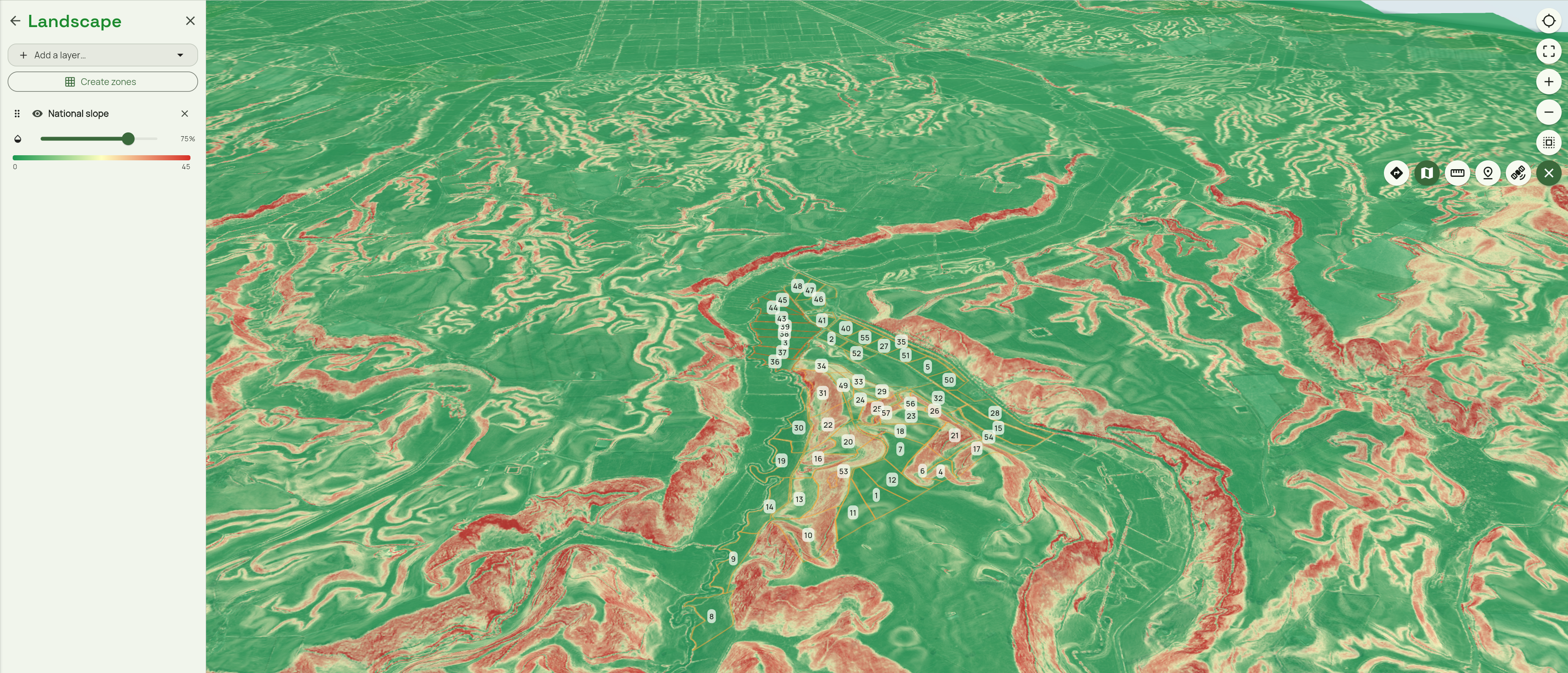
What started as a casual conversation between like-minded people who share a burning passion for farmers and the environment has now culminated in an official working relationship — one with the potential to deliver a complete paradigm shift at farm level.
Clint Rissmann’s work in the geospatial and environmental space is well documented. He has been pivotal in several on-farm and catchment-scale projects, delivering invaluable insights into water-quality outcomes and the powerful influence of landscape on environmental performance.
ReviveAg has transformed how precision agriculture is applied in New Zealand. It has given farmers and advisors clearer visibility of soil nutrient levels and variability, and the practical tools to move away from traditional blanket and maintenance approaches toward fully incorporating the 4R principles of precision agriculture: the right product, in the right place, at the right time, and at the right rate.
Together, these two complementary strengths are helping reshape decision-making across New Zealand farms.
Why this collaboration matters
New Zealand’s geology is among the most complex in the world. Neighbouring paddocks — or even parts of the same paddock — can behave very differently because of what sits under the surface. Traditional one-size-fits-all nutrient or mitigation advice often misses this variation, leading to inefficient fertiliser use, higher costs, and suboptimal environmental results.
ReviveAg is a New Zealand-built software platform designed for independent farm consultants and the farms they advise. It supports intensive soil testing (transects, composites or grid sampling), nutrient mapping, variable-rate recommendations, annual fertiliser plans with current pricing, and map-centric visualisation across dairy, sheep & beef, arable and horticulture. The platform emphasises independent advice with no product-sales conflicts, helping tailor inputs to where they are actually needed.
Farmpulse, led by Dr Clint Rissmann (Director and Principal Scientist at Land & Water Science) and colleagues, builds on years of physiographic science. It integrates soil, geology, topography, climate, hydrology and water-quality data to explain why water-quality outcomes and contaminant losses vary so dramatically across New Zealand — often more due to the natural landscape than land-use intensity alone. Landscape factors such as aspect, elevation, slope, soil type and water table can account for 30–70% of productivity variation within a farm and can drive twice the variability in water quality and greenhouse-gas outcomes compared with land use by itself. The approach helps identify susceptibility to losses of nitrogen, phosphorus, sediment and microbes, and points to the most effective on-farm actions for each landscape setting.
The power of combining the two
Bringing high-resolution soil and nutrient data (ReviveAg’s strength) together with landscape-process understanding (Farmpulse / Rissmann’s science) creates a far more complete picture:
- Targeted nutrient management that respects both measured soil fertility and the landscape’s natural ability to retain or lose nutrients.
- Smarter placement of mitigations — knowing where sediment traps, detainment structures or changes in grazing intensity will actually deliver results.
- Better productivity and environmental performance on the same land base, because decisions are grounded in both “what is in the soil now” data and “how this landscape processes water and contaminants.”
- Stronger support for independent advisors who can deliver defensible, farm-specific plans without commercial bias.
Rissmann has long described the landscape as the “engine room” of a farm business. Understanding it gives farmers confidence in both production and mitigation decisions. Precision platforms like ReviveAg turn that understanding into practical, day-to-day recommendations and plans that consultants and farmers can implement and track.
Changing the agricultural landscape in practice
Across catchments from Southland to the Bay of Plenty and beyond, this integrated approach is already influencing how progressive farmers and advisors work. High-resolution soil scanning and mapping combined with physiographic insight help identify where productivity is constrained by landscape factors and where environmental risk is concentrated. The result is more efficient use of fertiliser and other inputs, reduced losses to waterways, and greater resilience.
For independent consultants, platforms that can layer environmental and soil data while remaining brand-neutral amplify their ability to give genuinely tailored advice at scale. For farmers, it means moving away from historic blanket practices toward evidence-based strategies that protect both the bottom line and the environment.
Looking ahead
New Zealand agriculture faces ongoing pressure to lift productivity while meeting water-quality, climate and market expectations. The combination of precision soil and nutrient tools with deep landscape science offers a practical path forward: less guesswork, more targeted action, and decisions that work with the natural variation of Aotearoa’s land rather than against it.
Collaboration across different sectors and specialists is integral to securing a more productive and sustainable agricultural landscape. No single business or industry body holds all the knowledge or skillsets needed to equip farmers with the recipe for success in the agricultural value chain of the future. We are far more likely to future-proof ourselves when we create the opportunity to combine and leverage the different strengths of every role player — with the farmer as our common focus.